

Building a Monopoly Wall Art Collection: The Long Game
A strong Monopoly wall art collection should feel like a point of view: not a themed shopping spree.
The difference is curation. Anyone can buy a single board-game print, hang it above a desk and call the room finished. A collector thinks further ahead. They ask what the artwork says about ambition, risk, wealth, independence and play. They consider how one piece will speak to the next, how the collection might evolve and when a work deserves to be rotated rather than permanently displayed.
That is the long game.
Whether you are starting with one bold canvas or already have a stack of framed pieces waiting for their moment, a Monopoly-inspired collection can become vibrant, personal and surprisingly sophisticated. The key is to build a visual language instead of repeating the same image in different sizes.
Start with a collecting thesis, not a shopping list
Before you buy, decide what you want your collection to communicate.
Monopoly imagery naturally carries ideas of property, negotiation, competition and financial ambition. But your interpretation could be playful, nostalgic, political or sharply contemporary. Perhaps you are drawn to the familiar board, tokens and property colours. Maybe you prefer street-art reinterpretations that use money as a symbol of freedom, pressure or social status.
Write down three to five words that define your direction. For example:
- Risk
- Independence
- Nostalgia
- Ambition
- Play
- Financial freedom
- Rebellion
This short list becomes your filter. If a new piece looks exciting but does not support the collection’s central idea, consider leaving it behind. Collecting is not about owning everything. It is about knowing why a particular work belongs.
You could also choose a setting-based direction. A study might lean into ambition and strategy, while a games room could carry more nostalgic colour. In a living room, a quieter monochromatic work might balance louder red, yellow and electric-blue pieces.
Build your Monopoly wall art collection in visual tiers
A compelling collection usually develops in layers. You do not need to acquire the most expensive work first. Instead, allow each tier to perform a different job.
1. Choose one anchor piece
Start with a work that establishes scale, colour and attitude. This could be a large pop art canvas, an original painting or a framed statement print.
The anchor should have enough visual weight to hold the wall on its own. Look for strong composition, confident contrast and a subject or symbol that will still interest you after the novelty fades.
A large work can also act as the collection’s emotional centre. If your theme is financial independence, a piece about taking control may be more powerful than one that simply displays a familiar board-game reference.
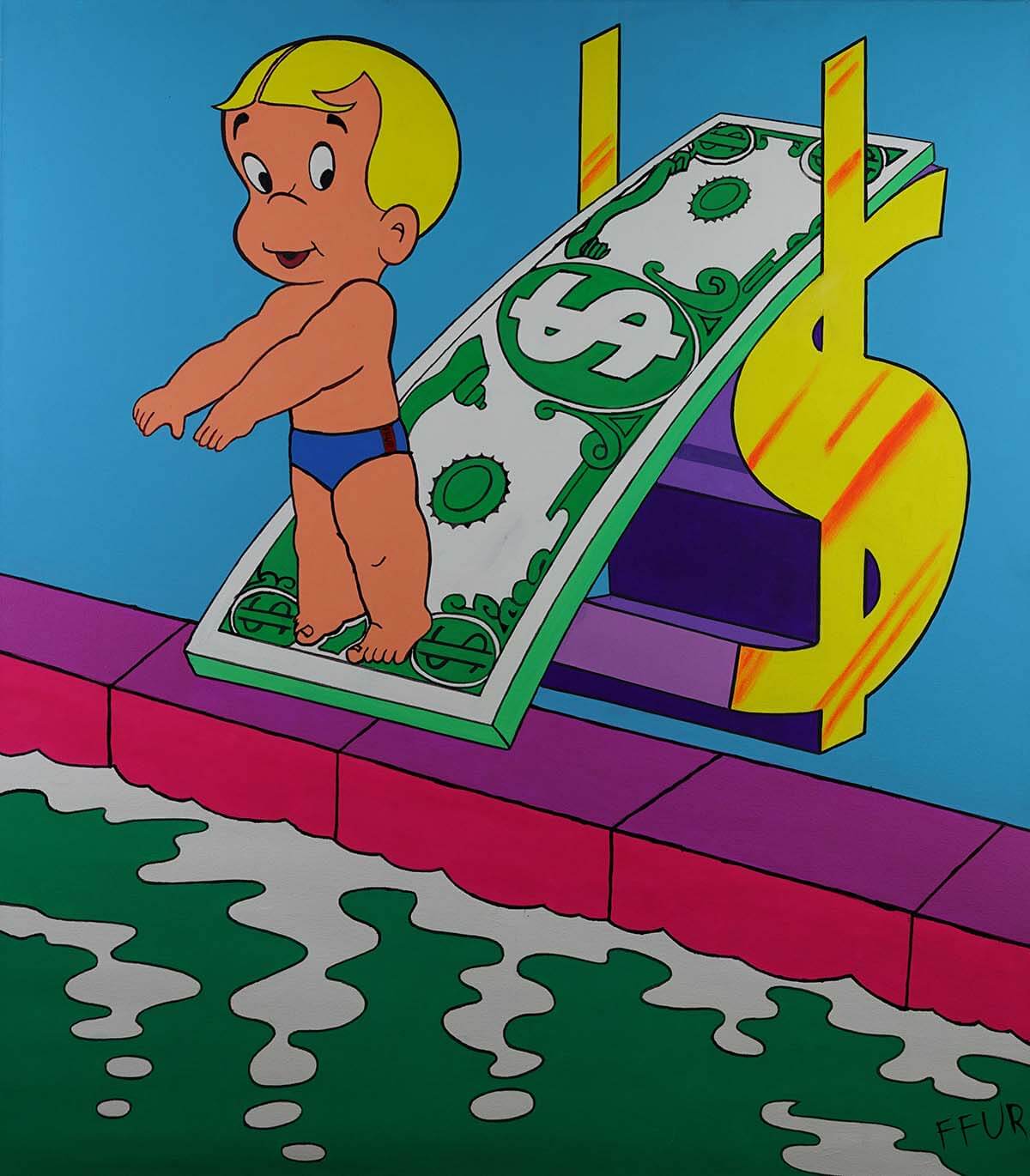
FFUR’s Original Art collection is a useful example of this approach. Rather than treating wealth as a decorative motif, the collection frames it through ideas of independence, risk and freedom. Works such as Money Dive and Stretching Dollar show how money-focused imagery can become a wider visual statement.
2. Add supporting works
Once you have an anchor, build outward with smaller pieces. These could include limited editions, framed posters, acrylic prints or graphic works that share one or two traits with the centrepiece.
Do not make every piece match perfectly. Instead, repeat selected elements:
- A shared colour such as canary yellow or racing green
- Similar black outline work
- Repeated property-grid geometry
- Currency marks or numerical patterns
- A consistent frame finish
- A balance between text-heavy and image-led works
This is where a collection starts to feel intentional. The pieces do not need to depict the same subject. They simply need to converse.
FFUR’s Acrylic Print collection demonstrates how a glossy finish can add contrast to more tactile canvas and paper works. Acrylic can bring a sleek, luminous surface into a wall that otherwise feels raw and textured.
3. Introduce one unexpected piece
Every serious collection benefits from tension.
If your wall is full of bright primary colours, consider adding a black-and-white sketch or a muted earthy work. If the imagery is highly graphic, introduce a piece with visible brushwork or distressed canvas. If everything is framed symmetrically, allow one work to lean casually on a shelf.
This prevents the collection from becoming a gimmick. A little friction gives the eye somewhere to travel.
Plan the wall like a game board
A successful gallery wall is not just a group of pictures. It is a composition.
Begin by measuring the wall and laying the frames on the floor. Use paper templates if you are working with valuable originals. This allows you to test the spacing, height and visual rhythm before making holes.
For a layered collector’s corner, consider combining:
- One large horizontal anchor
- Two medium works at different heights
- Smaller framed pieces filling the visual gaps
- One acrylic print to introduce reflective depth
- A low, leaning work for a relaxed studio feel
Uneven spacing can work beautifully with street art, but it should still feel deliberate. Align one edge or create a clear vertical rhythm to keep the arrangement from becoming chaotic.
The FFUR Canvas Wall Art collection also offers a useful reminder: measure your wall before selecting the artwork. A bold piece needs enough breathing room to feel powerful. Crowding can flatten even the most vibrant composition.
Grow slowly and document every acquisition
A long-term collection should have room to mature.
You might begin with a framed print, add an acrylic edition the following year and eventually acquire an original. That progression is not a compromise. It is a record of your taste developing over time.
Keep a simple collection log with:
- Artist and title
- Date acquired
- Edition or originality details
- Medium and dimensions
- Purchase price
- Where the work is displayed
- Any framing or conservation information
This is especially worthwhile for original art. FFUR describes its original works as distinct pieces rather than mass-produced decoration, and the collection page gives useful context around the difference between original and edition artwork.
Documentation also helps you avoid accidental repetition. Before buying another red-and-yellow print, check whether your wall already has that visual role covered.

Rotate the collection to keep it alive
Rotation is one of the most effective ways to make a collection feel larger than it is.
You do not need a new wall every month. Instead, change the anchor piece two or four times a year. Move a quieter work into the centre and let a louder piece rest. Swap a motivational image from your office into the living room. Bring a nostalgic board-game print forward during the holidays or when you are hosting friends.
A simple seasonal structure could look like this:
- Spring: bright colour, movement and new starts
- Summer: playful nostalgia and high-energy pop art
- Autumn: earthy neutrals, texture and reflection
- Winter: darker contrasts, ambition and long-term goals
Rotation can also protect your artwork. Light is cumulative, and works on paper are particularly vulnerable to fading. The Canadian Conservation Institute’s guidance on caring for art on paper recommends avoiding direct sunlight and paying close attention to display conditions.
Consider using UV-filtering glazing for framed paper works, keeping pieces away from radiators and storing unmounted prints flat in archival sleeves. Stable conditions are generally more helpful than constantly changing temperature and humidity.
Mix collectible quality with everyday accessibility
A Monopoly wall art collection does not need to be made entirely from rare originals. In fact, combining different formats can create a more dynamic display.
You could pair:
- An original canvas with a museum-quality poster
- A glossy acrylic print with a raw-edge canvas
- A large statement work with affordable graphic studies
- A framed edition with a smaller work on paper
The goal is not to make every piece equally valuable. The goal is to give every piece a role.
Originals bring scarcity and personality. Acrylic prints deliver vivid contrast and a sleek, contemporary finish. Canvas prints can introduce texture and scale. Framed posters make it easier to expand the collection without exhausting your budget.
This layered approach also makes rotation more practical. You can move lower-risk works around more freely while giving your most valuable pieces a considered, lower-light position.
Know when to stop adding
The strongest collections are edited.
When your wall begins to feel crowded, pause before buying more. Live with the arrangement for a few weeks. Notice which pieces you look at most often and which ones disappear into the background.
If one work no longer connects with your collecting thesis, rotate it into storage rather than forcing it to remain on display. You might rediscover it later in a new room or alongside a different colour palette.
You could also use a “one in, one out” rule for smaller works. This keeps the collection focused and encourages you to acquire only pieces that genuinely move it forward.
Make the long game personal
The best Monopoly wall art collections are not really about Monopoly.
They are about the ideas the imagery unlocks: the thrill of risk, the discipline of patience, the fantasy of ownership, the pressure of competition and the desire for independence. Your wall should reflect your relationship with those ideas: not simply reproduce a familiar character or colour scheme.
Start with one piece that has real presence. Build around it with contrast, texture and intention. Document what you own. Rotate the display before it becomes stale. Protect the work so it can stay with you for years.
That is how a themed wall becomes a collection: and how a collection becomes part of your story.